
The 6 Daily Choices That Make Your Hair Better or Worse
May 14, 2026
The 6 Daily Choices That Make Your Hair Better or Worse
A complete guide to understanding how what you drink, eat, breathe, put on your skin, how you sleep, and what you think directly impacts your hair loss — and what you can do about it today.
By Saril Vasquez, CFNC, TCDP, CEI — Founder of Bellechanics
🌋 Ready to put all your puzzle pieces together? Join me FREE for The Becoming a Bellechanic Method — a 2-day live event where you'll learn exactly what YOUR body needs to stop hair loss naturally. Reserve My Free Spot Here
Your hair loss isn't random. It's not just genetics. And it's not something you're completely powerless against.
Your hair is responding — every single day — to the choices you make. What you drink, what you eat, what you breathe, what you put on your skin, how you sleep, and what you think are all sending signals to your body about whether to prioritize hair growth or survival mode.
The problem is, nobody taught you to connect these dots. You've been told hair loss is either cosmetic (use shampoos and serums) or medical (take medications). You've been taught to rely on specialists and supplements instead of learning to read what your own body is telling you.
This guide changes that.
Inside, you'll discover exactly HOW each of these 6 daily choices either supports or sabotages your hair — and what you can do starting today to shift the needle in your favor.
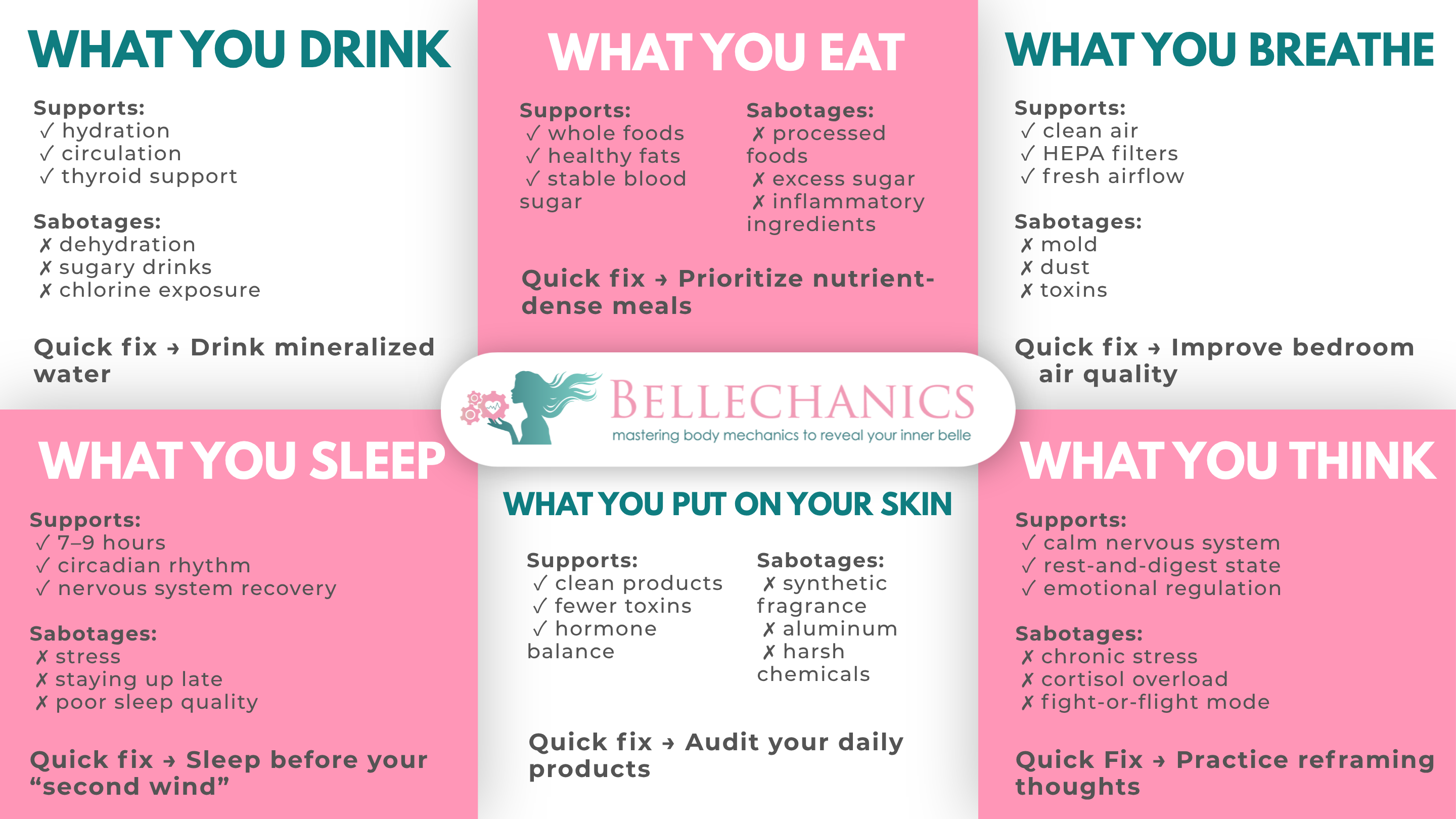
WE PRESENT, YOUR SIX DAILY CHOICES:
1. What You Drink
How it affects your hair
Water is the foundation of every biological process in your body. When it comes to your hair, proper hydration directly affects:
- Gut lining restoration — Your intestinal barrier needs water to repair itself. A damaged gut lining means poor nutrient absorption, which starves your hair follicles.
- Terrain pH balance — Dehydration creates a more acidic terrain, which triggers inflammatory responses that deprioritize hair growth.
- Blood viscosity and circulation — Dehydration thickens your blood, making it harder to circulate. Thick blood means oxygen and nutrients move slowly to your scalp.
- Toxin clearance — Water dilutes toxins, allowing your liver and kidneys to process them efficiently.
- Thyroid function — Your thyroid controls metabolism and hair growth. Dehydration impairs thyroid efficiency.
The hidden toxin — Chlorine: When you shower without a filter, you inhale chlorinated steam that enters your bloodstream. Chlorine, bromine, and fluoride all compete with iodine for thyroid receptors — impairing thyroid function even if you're eating iodine-rich foods.
Demineralized water: Distilled or reverse osmosis water that hasn't been remineralized actually leeches minerals from your body. Your system steals minerals from itself just to process the water you're drinking. This is why some people drink water and feel thirstier, not less thirsty.
✓ What supports hair growth
Drinking enough quality water dilutes your blood for better scalp circulation, helps your liver and kidneys flush toxins efficiently, maintains an alkaline terrain with less inflammation, and supports gut lining repair and nutrient absorption.
✗ What sabotages hair growth
When you're dehydrated, your body pulls water from your colon to dilute blood and protect your kidneys — especially when you eat high-sugar foods. This causes constipation, microbiome disruption, and decreased nutrient absorption. When you eat a lot of sugar, you tend to get dehydrated or constipated because your body is taking water out of your colon to dilute the high blood sugar, protecting your organs from damage.
Action Steps: What You Drink
Step 1 — Establish your baseline Drink a minimum of half your body weight in ounces daily. If you weigh 150 lbs, drink at least 75 oz.
Step 2 — Monitor your body's signals Keep drinking if any of these apply:
- Your urine isn't a pale yellow color
- You have body odor (proper hydration naturally eliminates it)
- You're constipated — water was pulled from your colon, drink more to flush it
- You still feel thirsty
Step 3 — Remineralize your water If you're drinking distilled or reverse osmosis water that hasn't been remineralized, add 1 teaspoon of Celtic sea salt or pink Himalayan salt per 32 ounces of water. This restores minerals and prevents the "still thirsty" paradox. → Get Recommended Sea Salt
Step 4 — Filter your shower water Install a shower filter to remove chlorine, fluoride, and bromine. I recommend the eSkin filter — specially formulated to protect your hair and body from chemical exposure. → Get the eSkin Shower Filter
Step 5 — Drink water away from meals Drink water between meals, not with food. Water consumed with meals dilutes your stomach acid, impairing digestion and nutrient absorption. Drink at least 20-30 minutes before eating or 1-2 hours after.
Step 6 — Use green juice for extra support If you're constipated, low-sugar green juices (cucumber, celery, leafy greens) help flush your colon naturally while providing additional hydration — without spiking blood sugar.
2. What You Eat
How it affects your hair
Food is not just fuel. Food is information. Every bite you take tells your body either "prioritize hair growth" or "activate survival mode."
The 4-6 hour deprioritization effect: When you eat inflammatory foods, GMOs, glyphosate, or high amounts of sugar, your body pulls blood flow away from nonessential tissues like your hair and redirects it to your core organs. This deprioritization lasts 4-6 hours per meal. If you're eating inflammatory meals for breakfast, lunch, and dinner — you're deprioritizing blood flow to your scalp all day long.
We don't eat just to feel full. We eat to feed the trillions of cells living inside us. When you eat whole foods your body recognizes, you're feeding healthy cells. When you eat processed foods, you're feeding dysfunction — parasites, bacterial overgrowths, candida — that deprioritize hair growth.
✓ What supports hair growth
Eating nutrient-dense whole foods stabilizes blood sugar, feeds your hair follicles the vitamins and minerals they need to grow, supports your microbiome, and keeps your liver functioning optimally for hormone balance.
✗ What sabotages hair growth
Foods full of GMOs, glyphosate, synthetic ingredients, and refined sugar trigger immune responses that divert blood flow from your scalp for 4-6 hours. They feed pathogenic bacteria and parasites in your gut, burden your liver (already responsible for 500+ functions including hormone balance), and create a chronic acidic inflammatory terrain. Most of us have been told "food doesn't matter" for hair loss — this is simply false.
Action Steps: What You Eat
Step 1 — Identify your inflammatory foods Notice which foods make you feel worse — bloating, brain fog, fatigue, increased hair shedding. These are your body's clues that something doesn't work for it.
Step 2 — Focus on nutrient-dense whole foods
- Grass-fed or pasture-raised meat
- Wild-caught fish
- Organic vegetables (especially leafy greens)
- Healthy fats (avocado, coconut oil, olive oil)
- Pasture-raised eggs
- Bone broth
Step 3 — Avoid inflammatory foods Avoid foods with glyphosate, GMOs, synthetic ingredients, and refined sugar. These create a 4-6 hour blood flow deprioritization from your scalp every single time you eat them.
Step 4 — Track what you eat and how your body responds Pay attention to how you feel 1-2 hours after eating — energy level, digestion, mental clarity, and hair shedding. Your body is giving you data constantly. Learn to read it.
Step 5 — Consider a Continuous Glucose Monitor (CGM) Using a CGM for 2-4 weeks is incredibly helpful for understanding exactly how different foods affect your blood sugar — and your hair. It shows you real-time data on which foods spike your blood sugar and which keep it stable, removing the guesswork entirely. You'll learn the full food tracking method inside the Becoming a Bellechanic event.
3. What You Breathe
How it affects your hair
Your lungs are your gateway to your bloodstream. Whatever you breathe in goes directly into your lungs, then into your blood, then circulates throughout your body. Your body is a walking recycling machine — it has to process everything you breathe in.
Think about why smokers develop lung cancer. When you breathe toxins into your lungs, some enter your bloodstream and circulate throughout your body. Some stay in the lung tissue itself, injuring the cells. When your body can't detoxify those trapped toxins, they accumulate in lung cells. Over time, those damaged cells begin to replicate. The same principle applies to your scalp on a smaller scale — every toxin you breathe becomes a burden diverting resources away from hair growth.
✓ What supports hair growth
Breathing clean air reduces your immune system burden, decreases toxin load on your liver and kidneys, reduces nervous system stress, and allows your body to allocate resources to hair growth instead of detoxification. Clean air while you sleep is especially critical.
✗ What sabotages hair growth
When your body detects airborne toxins — toxic mold, dust (made of dead skin cells, synthetic fabric fibers, feather particles, mold spores), asbestos, or chlorine from unfiltered showers — it activates a chronic immune response. Your immune system gets stuck in overdrive, creating inflammation that diverts resources away from hair growth.
Dust isn't just "dirt." It's a mixture of dead human skin cells, synthetic fabric fibers breaking down, feather particles from pillows and comforters, mold spores, and dust mites. If it's not organic material your body recognizes, it's a toxin your body has to process. Some people develop severe dust allergies because their immune system is chronically activated from poor air quality.
Action Steps: What You Breathe
Step 1 — Dust and vacuum regularly (this is a minimum, not a ceiling) Dust and vacuum your home at least once per week for every person living in your home:
- 1 person = 1x per week minimum
- 2 people = 2x per week minimum
- 3 people = 3x per week minimum
- Active mold situation = 3-4x per week
Pro tip: Attach a green light to your vacuum to see exactly how much dust is accumulating in your environment. → Get the Green Light Vacuum Attachment
Step 2 — Invest in clean air tools Use a HEPA air purifier in every room, especially your bedroom where you sleep 8 hours. I recommend the Silent HEPA Air Cleaner for each room, and the Dyson Gen5detect as your vacuum — it already has the green light detection built in. → Get the Silent HEPA Air Cleaner → Get the Dyson Gen5detect HEPA Vacuum
Step 3 — Address mold in your home Nearly every home has mold — the question is how much and is it toxic? Check bathrooms, basements, attics, and around windows. Fix moisture sources, repair leaks, and maintain indoor humidity between 40-60% (mold thrives above 60%). Consider a professional mold inspector if you suspect significant contamination.
Step 4 — Service your HVAC system Change air filters monthly. Have your system professionally cleaned annually. Consider upgrading to HEPA filters.
Step 5 — Get fresh air outside Get outside and breathe fresh air regularly. Open your windows when weather permits — but only if you don't live near construction sites, highways, or areas with heavy air pollution.
4. How You Sleep
How it affects your hair
Sleep is when your body does its most important repair work. During deep sleep, something extraordinary happens in your brain:
Your brain shrinks by 60%. Your glial cells (the support cells in your brain) shrink during sleep, creating space for your lymphatic system to flush out metabolic waste through your cervical lymph nodes. This is called the glymphatic system, and it works most efficiently during sleep.
Your hair lives at the top of your head — the farthest extremity from your heart. It's the last place to receive blood flow and the first place to lose it when circulation is compromised. Good sleep enables both the blood circulation AND lymphatic clearance your scalp needs to grow hair.
✓ What supports hair growth
Quality sleep (7-9 hours) allows your glymphatic system to efficiently clear metabolic waste from your cranial area, resets your circadian rhythm, balances your thyroid and reproductive hormones, reduces systemic inflammation, and allows your body to allocate resources to hair growth instead of survival mode. Clean air while you sleep is one of the most important factors for hair health.
✗ What sabotages hair growth
When you ignore tiredness and stay up, your body releases cortisol to keep you awake — you get a "second wind." This cortisol surge keeps your nervous system in fight-or-flight, makes your glymphatic system less effective at clearing waste from your brain, reduces blood circulation to your scalp, and keeps your body in survival mode instead of growth mode.
Hidden dental infections (root canals, cavitations, infections under crowns) create a chronic immune response in your head. Your body has to allocate extra blood flow and lymphatic drainage just to manage the infection — competing directly with resources needed for hair growth.
Action Steps: How You Sleep
Step 1 — Prioritize 7-9 hours nightly When you feel tired, go to sleep — don't push through it. That second wind is cortisol rising to keep you awake, and it's sabotaging your hair.
Step 2 — Regulate your circadian rhythm Go to bed at the same time each night, even on weekends. This regulates your thyroid, reproductive hormones, and cortisol — all critical for hair growth.
Step 3 — Block blue light before bed Avoid screens 30-60 minutes before bed. Blue light suppresses melatonin production and delays sleep onset. I recommend amber blue light blocking glasses. → Get Blue Light Blocking Glasses
Step 4 — Sleep in clean air Use a HEPA air purifier in your bedroom. Dust and vacuum regularly. Wash bedding weekly. Clean air while you sleep is non-negotiable for hair health. → Get the Silent HEPA Air Cleaner
Step 5 — Address hidden dental infections Consider having any chronic dental infections addressed by a qualified practitioner. Hidden infections compete with resources needed for hair growth.
5. What You Put on Your Skin
How it affects your hair
This is one of the most underestimated factors in hair loss.
Everything you put on your skin goes directly into your bloodstream. This isn't theory — it's why dermatologists prescribe hormone therapies as skin creams. Testosterone gels and estrogen creams work because they absorb transdermally into the bloodstream. If beneficial compounds absorb through skin, so do toxins.
✓ What supports hair growth
Using clean personal care products reduces the toxin load on your liver and endocrine system. Your liver is responsible for 500+ functions including hormone balance. The fewer toxins it processes, the more efficiently it can support hormonal harmony — which is critical for hair growth.
✗ What sabotages hair growth
- Fluoride toothpaste — absorbed through your mouth's mucous membranes, fluoride competes with iodine for thyroid receptors, just like chlorine does
- Synthetic fragrances — contain endocrine disruptors that interfere with hormone balance
- Anti-aging creams with endocrine disruptors — absorbed directly into bloodstream, disrupting reproductive hormones and thyroid function
- Aluminum deodorant — your body recognizes aluminum as a toxin. When aluminum levels get too high, your body sheds it through hair faster because shedding hair is one way to eliminate heavy metals. High aluminum = more hair shedding.
- Synthetic personal care products — lotions, shampoos, conditioners, body wash — anything synthetic that touches your skin creates a toxin load your liver has to process
Action Steps: What You Put on Your Skin
Step 1 — Switch to fluoride-free toothpaste Fluoride is an endocrine disruptor that interferes with thyroid function. Switch immediately. → Get Fluoride-Free Toothpaste
Step 2 — Replace synthetic fragrances with essential oils Synthetic fragrances contain endocrine disruptors. Use essential oils instead. I personally love applying a parasympathetic blend behind my ears — not just to fragrance myself, but to support my nervous system. → Get the Parasympathetic Essential Oil Blend
Step 3 — Switch to clean deodorant Ditch aluminum deodorant. Besides drinking sufficient water (which naturally reduces body odor), this is what I use to deodorize. → Get Olive Gold O3 Skin Care Oil
Step 4 — Replace shaving cream Most shaving creams contain synthetic chemicals that absorb directly into your skin. Switch to a clean body oil alternative. → Get Shankara Harmonizing Body Oil
Step 5 — Switch to clean makeup Everything you apply to your face absorbs into your bloodstream. I've found Stone and Spear to be the cleanest option — it includes makeup, anti-aging creams, soaps, and more. → Shop Stone and Spear Clean Beauty
Step 6 — Audit everything you use Check every product you apply — anti-aging creams, moisturizers, serums, sunscreen, shampoo, conditioner, body wash. If you can't pronounce an ingredient, it's likely a chemical your liver has to process. The fewer toxins on your skin, the more efficiently your liver can balance your hormones and support hair growth.
6. What You Think
How it affects your hair
Your thoughts are incredibly powerful. A single thought can trigger cortisol — your body's stress hormone.
The perceived danger response: You almost get into a car accident — but you don't. Nothing actually happens. Yet your heart races, your breathing increases, and you feel pain in your body. That's cortisol flooding your system from a perceived threat. Chronic stress from a boss that bullies you, a draining marriage, a rebellious child, or ongoing conflict triggers this same response — keeping you in fight-or-flight constantly.
When you're in fight-or-flight, your body doesn't produce enough stomach acid. It compensates by creating more bacteria to break down food through fermentation in your gut. This creates an acidic terrain, which is inflammatory. An acidic, inflammatory body does not prioritize hair growth.
✓ What supports hair growth
When you stay in "rest and digest" mode (parasympathetic nervous system), your body digests food more efficiently, produces adequate stomach acid, maintains proper pH, prioritizes blood flow to your scalp, and balances reproductive hormones and thyroid function. Managing your emotional state is a direct investment in your hair.
✗ What sabotages hair growth
Chronic fight-or-flight produces excess cortisol, reduces stomach acid production (impairing digestion and nutrient absorption), creates an acidic inflammatory terrain, and deprioritizes blood flow away from your scalp to your core organs. The more you're in fight-or-flight, the more dysfunctional your reproductive hormones, thyroid, and gut function become — and the less your body prioritizes hair growth.
Action Steps: What You Think
Step 1 — Pause and acknowledge your thoughts When you notice stress, anxiety, or a negative thought, pause and acknowledge it. Don't try to suppress it — just notice it's there.
Step 2 — Ask yourself three questions
- "Is this how I actually want to feel?"
- "How do I want to feel instead?"
- "What do I have to think in order to feel that way?"
You may not be able to control your initial thought immediately — that takes years of practice. But you can absolutely influence your second thought and how quickly you redirect.
Step 3 — Practice daily reframing Instead of focusing on what's going wrong, practice searching for what's going right. This simple shift keeps your nervous system regulated — and your body in the rest-and-digest state that supports hair growth.
Step 4 — Stay in rest and digest When you're calm and regulated, your digestion improves, nutrient absorption increases, your pH stays alkaline, and blood flow is maintained to your scalp instead of being diverted to survival organs. Every moment in rest-and-digest is a moment your body can prioritize hair growth.
Step 5 — Enhance your communication skills When you're in conflict, try this approach:
- Repeat back what you hear the other person saying so they know you understand them
- Acknowledge their concern — validate that you hear them
- Disarm them by showing you're not against them
- Offer a new perspective — help them see another way to think about the situation
- Show the cost of the old thinking and what they could gain by being open to a new perception
This shifts conflict from defensive to collaborative, keeping you out of fight-or-flight and in a state where your body can heal and grow hair.
All Recommended Products in One Place
What You Drink: → eSkin Shower Filter → Celtic / Himalayan Sea Salt for Remineralizing Water
What You Breathe + How You Sleep: → Silent HEPA Air Cleaner → Green Light Vacuum Attachment → Dyson Gen5detect HEPA Vacuum (with green light built in)
How You Sleep: → Amber Blue Light Blocking Glasses
What You Put on Your Skin: → Fluoride-Free Toothpaste → Parasympathetic Essential Oil Blend → Olive Gold O3 Skin Care Oil (Natural Deodorant) → Shankara Harmonizing Body Oil (Replaces Shaving Cream) → Stone & Spear Clean Beauty (Makeup, Skincare, Soaps)
Ready to Put All Your Puzzle Pieces Together?
Now that you understand the 6 daily choices that are affecting your hair, the next step is learning exactly what YOUR body needs — and becoming a master of your own body mechanics.
"Mastering your body mechanics is the only way to know what turns on and turns off your hair loss. Listening to your body is a skill set, and to master that skill set, you must become a Bellechanic."
Join me FREE for The Becoming a Bellechanic Method — a 2-day live event on May 20-21 where you'll learn:
- What YOUR real root causes are
- What you can do right now without a practitioner
- How to finally put all your puzzle pieces together so hair regrowth feels possible
Disclaimer: The content provided on this website serves solely for educational and motivational purposes and should not be construed as a substitute for advice from a qualified professional. Remember that results from remedies and protocols can vary from person to person, and should be part of a comprehensive approach for maximum effectiveness. Prior to initiating any new therapies, it is essential to seek guidance from healthcare professionals; preferably one that has experienced reversing hair loss naturally for his or herself and others. Certain hyperlinks on Bellechanics might be affiliate links, indicating that we may earn a commission, at no extra expense to you. By choosing to shop with associated links, you support the ability of continued articles and blogs that will serve as useful information for those in need. Bellechanics participates in the Amazon Services LLC Associates Program. Learn More
© 2025 Bellechanics | Saril Vasquez, CFNC, TCDP, CEI | bellechanics.com
Stay connected with news and updates!
Join our mailing list to receive the latest news and updates from our team.
Don't worry, your information will not be shared.
By providing your phone number, you agree to receive text messages even if you are on the do-not-call list.
We hate SPAM. We will never sell your information, for any reason.
